
Enhanced Oil Recovery (EOR)
Oil Chem Technologies is a technology provider of surfactants used for Chemical Enhanced Oil Recovery (EOR) including ASP and SP.
ASP
In the Alkaline Surfactant Polymer (ASP) process, a very low concentration of the surfactant is used to achieve ultra low interfacial tension between the trapped oil and the injection fluid/formation water. The ultra low interfacial tension also allows the alkali present in the injection fluid to penetrate deeply into the formation and contact the trapped oil globules. The alkali then reacts with the acidic components in the crude oil to form additional surfactant in-situ, thus, continuously providing ultra low interfacial tension and freeing the trapped oil. In the ASP Process, polymer is used to increase the viscosity of the injection fluid, to minimize channeling, and provide mobility control.
SP
In the Surfactant Polymer Flood (SP) process, a very low concentration of low adsorption surfactant is used to achieve ultra low interfacial tension between the trapped oil and the injection fluid/formation water. SP eliminates scale issues and polymer degradation issues associated with ASP. The higher viscosity injection fluid results in oil recovery levels similar to ASP
Oil Chem Technologies has been involved with one of the world’s first field-wide ASP projects starting in Daqing, China, using low-concentration, one component ORS-41 surfactant since 1995. Oil Chem Technologies has since provided over 80 million pounds of surfactants worldwide, which have been successfully injected at an average concentration of 0.1 wt% without co-surfactant, co-solvent, or salinity optimization. Oil Chem Technologies continues to develop innovative, effective, and economical surfactants based on the field results using their novel chemistries for EOR.
Oil Chem combines 20 years of actual field Chemical Enhanced Oil Recovery experience, patented state-of-the-art surfactant technologies, and strong alliances with world-class chemical manufacturers to provide field-proven surfactants for EOR.
Oil recovered,bbl, per bbl Oil Chem ASP surfactant injected

Oil Chem Enhanced Oil Recovery EOR Surfactants
| Chemical Types | Oil Chem Product Lines |
|---|---|
Internal Olefin Ether Sulfonates 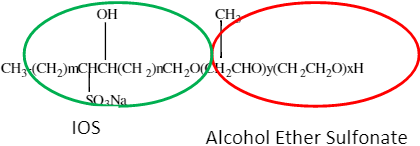 | SuperSurfTM Series for Sandstone and Carbonate Reservoirs – ASP & SP
|
Alcohol Ether Sulfonates US Patent No. 7,629,299 & Patent Pending | Super SurfactantTM Series for Sandstone and Carbonate Reservoirs – ASP & SP
|
Alkyl Aryl Sulfonates US Patent No. 6,022,834; 6,043,391; 7,605,287; 7,678,937; 7,863,476 | ORSTM Surfactant Series for Sandstone and Carbonate Reservoirs – ASP
|
| Amphoteric Surfactants US Patent No. 7,556,098; 7,373,977 | Super SurfactantTM series for Carbonate Reservoirs – ASP & SP
|